
In today’s highly competitive digital marketplace, running a small business successfully requires not just hard work and dedication but also requires smart systems, seamless operations, and the ability to adapt to a quickly changing digital economy.
One of the impactful tools helping small businesses to make this transformation is modern payment systems.
Whether advanced POS systems, contactless payments, mobile wallets, UPI transactions, and online payment gateways, implementing new technology has changed the way businesses process transactions and manage daily operations.
Effective small business management depends on efficiency, accuracy, and financial visibility. Because with just traditional cash registers and manual keeping solely can no longer meet rising customer expectations or give a competitive advantage.
Rather by implementing integrated payment processing solutions, businesses can automate billing, tracking revenue in real-time, track inventory management, and make cash flow management simple within a centralized cloud-based platform.
Such automation of processes reduces human error, saves time, and improves overall operational efficiency.
Customer experience is equally important. They expect fast, secure, and flexible payment options like card payments, tap-to-pay technology, QR code payments, and seamless digital payment solutions.
Businesses that do not offer such conveniences risk losing sales to competitors who offer smoother checkout experiences.
A modern smart POS system not just enables fast transactions but also increases transaction security, enables omnichannel sales, and offers valuable sales analytics that helps to make data-driven decisions.
In this blog, we will explore how leveraging modern payment technology can help small businesses improve productivity, reduce operational costs, improve customer satisfaction, and scale sustainably.
Also Read: Top 5 Features Every Retailer Should Look in Modern Payment Terminal
Why Efficient Payment Systems Matter for Small Businesses
Small businesses usually function with limited staff, low budgets, and low profit margins. In such a competitive landscape, operational efficiency for small businesses is not optional, instead it is essential for survival and long-term growth.
Every minute saved at the checkout counter, every avoided billing error, and every financial insight gained from sales data can directly impact profitability.
If the existing payment process is inefficient then it can cause challenges during peak hours, frustrate customers with long waiting queues, more accounting errors, and lead to missed revenue opportunities.
Manual billing, disconnected systems, and delayed financial reporting makes operations further slower and make it harder for business owners to maintain control.
Modern payment systems are designed to overcome such challenges by automating transactions, improving financial visibility, and streamlining daily business processes.
Below are the important reasons why efficient payment systems are crucial for small businesses:
1. Faster Checkout Process
Speed plays an important role in shaping customer experience. Because long queues and slow payment processing can discourage customers from completing purchases, especially during peak hours.
Efficient payment systems enable:
- Contactless tap-to-pay transactions
- QR code payments
- Mobile wallet compatibility
- Instant card approvals
- Quick invoice generation
Enabling faster transactions reduces wait time and also increases convenience for customers. When customers experience a smooth faster checkout process, then there are high chances that they will return.A faster checkout process strengthens brand perception and increases customer loyalty.
Also Read: Retail Payment Methods Transforming the Market
2. Reduced Human Error
Manual billing systems often lead to mistakes in total and tax calculations, and discount applications. Even small billing errors can increase over time and impact profits.
While automated payment systems:
- Calculate taxes accurately
- Apply discounts consistently
- Generate precise digital invoices
- Record transactions automatically
By reducing human errors, businesses maintain financial accuracy and pricing integrity. This not just protects revenue but also builds trust with customers who expect transparent billing.
Also Read: Online Transaction Security Payment Processing in Ecommerce
3. Better Cash Flow Management
Clear, real-time insights into cash flow helps businesses to control expenses, pay suppliers on time, and manage payroll confidently, and effectively plan growth.
Without real-time insights, business leaders may struggle to track performance effectively.
Modern payment systems provide:
- Real-time revenue tracking
- Daily and weekly sales summaries
- Payment method breakdown reports
- Refund and chargeback monitoring
Having instant access to financial data, allows businesses to identify trends, adjust budget, and make informed buying decisions. Improved cash flow reduces financial uncertainty and strengthens business stability.
Also Read: Smart POS The Secret of Faster Checkout
4. Improved Record Keeping
Maintaining accurate documentation is essential for bookkeeping, audits, and tax preparation. Because depending on manual records wastes valuable time and also has the chances of costly mistakes.
While digital payment systems automatically store transaction logs, including:
- Sales industry
- Tax details
- Refund records
- Customer purchase data
Organized digital records make accounting processes simple and ensure compliance with regulatory requirements. This saves administrative time and reduces stress during tax season.
Also Read: Instant Approval Online Merchant Account
5. Data-Driven Decision Making
Modern payment systems provide built-in analytics that reveal business insights. Business owners can analyze:
- Best-selling products
- Peak business hours
- Seasonal sales patterns
- Customer purchasing behavior
- Average transaction values
These insights enable smarter decisions related to staffing, pricing, promotions, and inventory planning. Instead of depending on guesswork, businesses can use real data to guide growth strategies.
Key Strategies for Efficient Payment Management
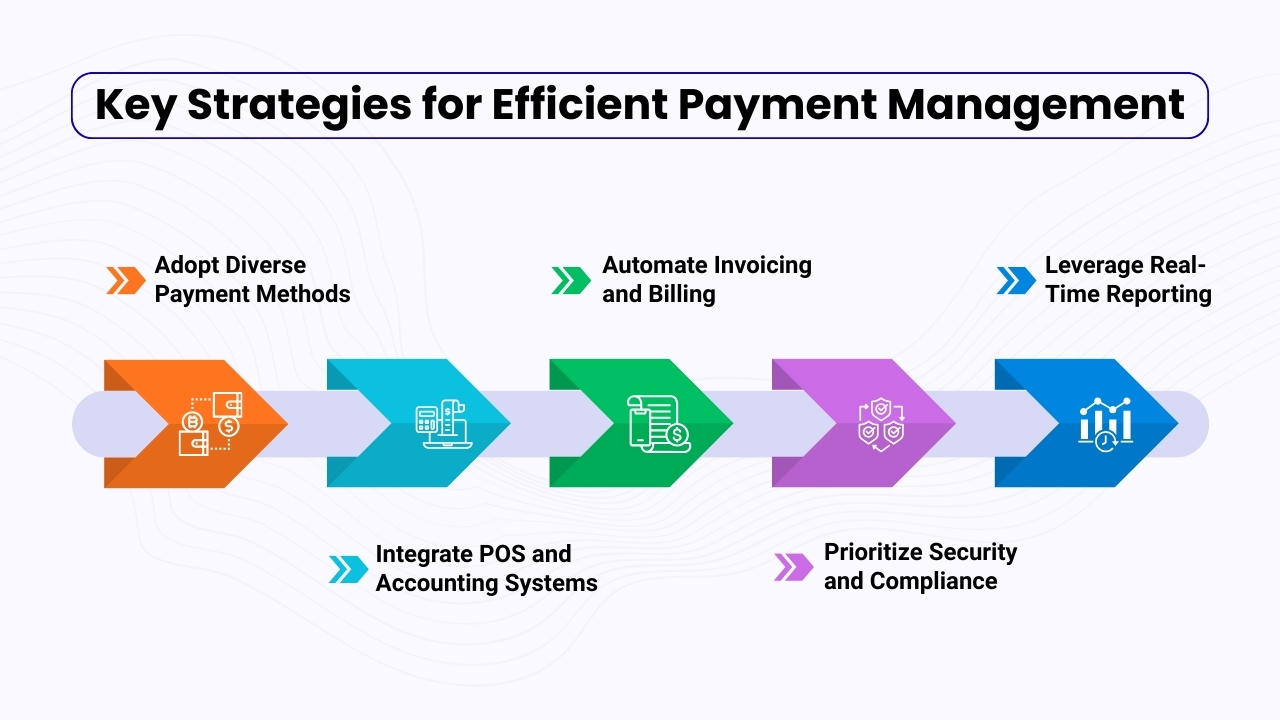
In today’s competitive market, small businesses must go beyond simply accepting payments that they must optimize how payments are processed, tracked, secured, and analyzed.
By implementing smart strategies, businesses can reduce errors, operational delays, and gain stronger financial control.
Below are five important strategies for efficient payment management:
1. Adopt Diverse Payment Methods
Offering multiple payment options allows customers to increase convenience while making payments and increase sales conversion rates. Modern consumers usually expect multiple payment options while buying.
Businesses should accept:
- Credit and debit cards
- Contactless tap-to-pay transactions
- QR code payments
- Mobile wallets such as Apple Pay and Google Pay
- UPI payments (where applicable)
- Online payment gateways
Enabling ACH transfers or eChecks for B2B transactions helps to reduce processing fees and speed up fund transfers while compared to traditional card payments.
Offering diverse payment options ensures that customers do not feel restricted by payment options. When you offer a payment system that is more accessible and flexible, then you can serve more customers effectively.
Also Read: What Payment Methods Should Retailers Accept
2. Integrate POS and Accounting Systems
Manually data entry often leads to financial mistakes and also waste valuable time of small businesses. Choosing a payment processor that integrates smoothly with your POS system and accounting systems enables data flow between platforms smoothly.
Advantages include:
- Automatic transaction recording
- Faster end-of-day reconciliation
- Reduced bookkeeping errors
- Real-time financial updates
This integration removes any repetitive administrative tasks and reduces inconsistencies between sales and accounting records. As a result, businesses can concentrate on growth strategies rather than just doing manual paperwork.
3. Automate Invoicing and Billing
Automating invoicing and billing improves cash flow management.Using digital invoices, automated payment reminders, and recurring billing systems helps businesses to reduce late payments and also improve revenue consistency.
Key advantages include:
- Faster payment collection
- Reduced follow-up efforts
- Predictable income streams
- Improved customer convenience
Subscription-based billing helps service providers generate predictable and stable revenue while maintaining steady cash flow.
4. Prioritize Security and Compliance
It is essential to prioritize security and compliance in payment management. Ensure that your systems are PCI DSS compliance and use technologies like tokenization and encryption to protect customer data.
Strong security measures:
- Reduce fraud risk
- Protect sensitive information
- Limit financial liability
- Build customer trust
Investing in secure systems protects both business and your reputation.
5. Leverage Real-Time Reporting
Cloud-based dashboards give instant access to sales trends, inventory levels, and financial performance metrics. Real-time reporting allows businesses to make faster decision-making, forecasting, and improved operational efficiency.
With having instant access to data insights, businesses get to manage resources effectively and drive long-term business growth.
Steps to Implement Modern Payment Systems
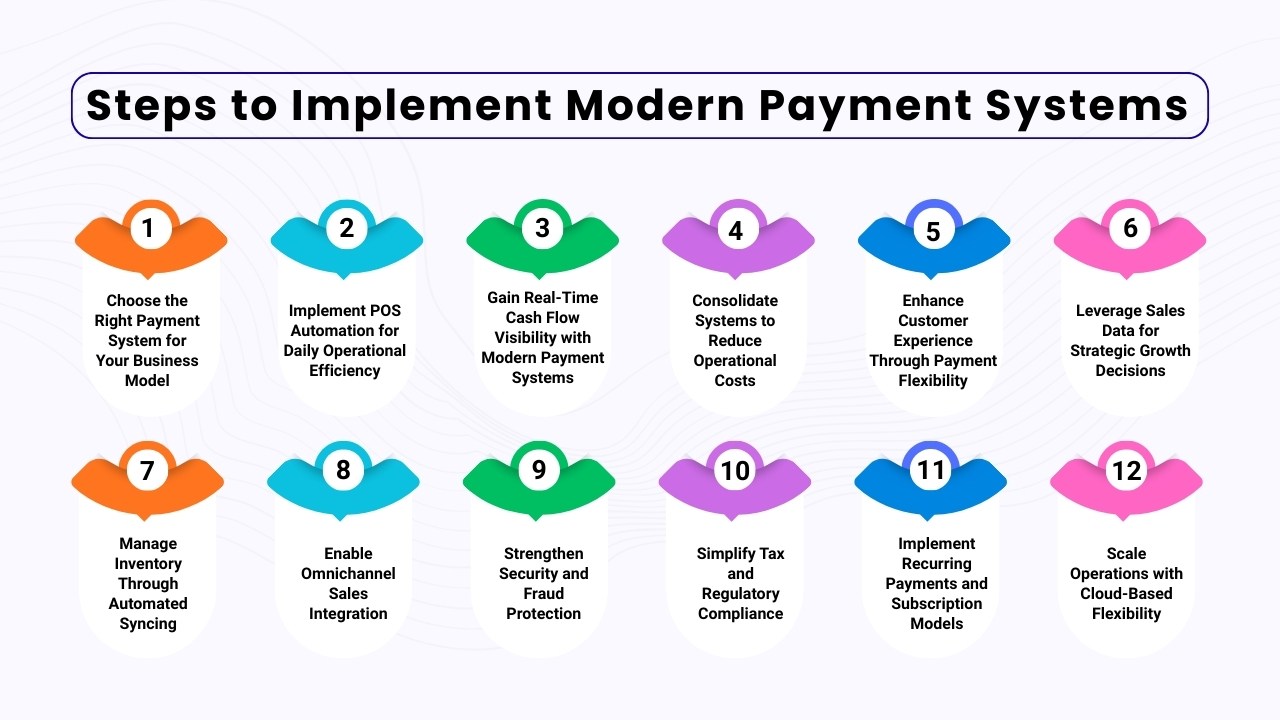
Implementing a modern payment system involves designing a connected, automated, secure, and scalable operational system that increases efficiency, customer satisfaction, and sustainable growth.
Customers today expect their payment systems to enable fast, flexible, and secure transactions. They want to pay using cards, contactless methods, mobile wallets, QR codes, online payment links, subscriptions, and even installment plans.
Businesses require simplified accounting, accurate reporting, real-time financial visibility, automation that reduces their manual workload and the systems that can scale when their business expands.
Modern payment systems provide these requirements, improving operational control while delivering a smooth customer experience.
Below is a detailed framework that will help small businesses to implement modern payment systems effectively and strategically.
1. Choose the Right Payment System for Your Business Model
The first essential step for implementing a modern payment system is to select a payment system which aligns with your business structure, industry requirements, and operational workflows.
Every business has their own unique processes, so choose the payment system that supports your business processes and not just adapt your business to incompatible systems.
For instance, retail stores usually required barcode scanning, SKU-level inventory tracking, returns management, discount automation, and real-time stock visibility.
While assessing a payment system, look for features that align with your business requirements and also ensure future business growth. Ensure that the system supports multiple payment options like credit/debit cards, UPI, QR codes, NFC, mobile wallets, and online payment gateways.
Further check whether the system integrates smoothly with accounting tools like Tally. Also check their CRM support, staff management processes, and real-time inventory tracking.
Select a system that offers customizable analytics dashboards, multi-location support, and flexible scalability options. Because only a scalable and flexible system ensures that your payment infrastructure evolves as your business expands.
By making the right decision since the start prevents costly migrations, operational interruptions, and retraining costs later.The right payment system ensures long-term efficiency and ensures sustainable growth.
Also Read: Payment Methods Vs Payment Processor
2. Implement POS Automation for Daily Operational Efficiency
After selecting the right payment system, implementing POS automation is essential for improving daily operations. Implementing manual billing processes consumes valuable time and also increases the chances of calculation errors, income tax entries, and pricing inconsistencies.
These inefficiencies can impact the level of customer satisfaction and financial accuracy negatively.
A modern POS system should automate:
- Tax calculations based on region and product category
- Discount and promotional offer applications
- Instant invoice and receipt generation
- Digital receipt delivery via email or SMS
- Real-time sales categorization and revenue tracking
- Inventory updates after each transaction
It should also categorize sales in real time and update revenue reports automatically. Additionally inventory levels should get updated instantly after each transaction to prevent stock discrepancies.
When financial summaries and inventory records get updated automatically, then businesses do not have to do end-of-day reconciliation manually which reduces errors and also saves administrative time.
Automating operational processes improves speed and accuracy, which allow employees to focus on customer engagement, upselling, and service quality. Ultimately technology manages tasks, businesses operate with more efficiency and staff get to focus on activities that drive growth and profitability.
Also Read: Retail Payment Methods Transforming the Market
3. Gain Real-Time Cash Flow Visibility with Modern Payment Systems
Improving cash flow is essential for any small business. Without having financial visibility, it becomes difficult for small businesses to manage daily expenses, pay suppliers on time, process payroll, or confidently invest in growth opportunities.
Having limited insight about revenue performance can often cause poor budgeting decisions and unexpected financial difficulties.
Modern payment systems provide:
- Real-time revenue monitoring
- Daily, weekly, and monthly financial reports
- Payment method breakdown analytics
- Refund and chargeback tracking
- Sales trend visualization
- Profit margin insights
These tools provide a complete overview of how money is flowing in and out of the business.
Having such a level of transparency, allows businesses to predict income more accurately and identify cash flow patterns instantly. It also helps businesses to detect peak sales hours, slow business hours, seasonal fluctuations, and customer payment preferences.
4. Consolidate Systems to Reduce Operational Costs
Many small businesses operate with disconnected systems for payment processing, accounting, CRM, and inventory management. This fragmentation increases subscription expenses and complicates workflows.
An integrated payment platform consolidates these functions into a unified ecosystem, reducing:
- Duplicate software subscriptions
- Manual data entry errors
- Reconciliation mismatches
- Administrative workload
- Staff training complexity
- Data inconsistencies
Automatic synchronization between payment transactions and accounting records streamline bookkeeping and ensure financial accuracy.
Consolidating these systems helps businesses to improve workflow efficiency and lowers operational costs over time. Having a unified system enhances internal coordination and also makes the management across departments simple. Businesses become more efficient when systems are connected and not isolated.
5. Enhance Customer Experience Through Payment Flexibility
Customer expectations have been evolving rapidly. Today’s consumers demand their payments to be fast, convenient, and secure. Businesses that offer flexible payment options often have a significant competitive advantage.
Modern payment systems offer:
- Multiple payment methods
- Contactless tap-to-pay transactions
- QR code payments
- Mobile wallet compatibility
- Online payment links
- Digital receipts
- Loyalty program integration
Enabling faster checkout significantly reduces wait times and improves overall customer satisfaction. Implement loyalty integrations that reward repeat purchases and encourage long-term engagement.
A seamless payment experience helps businesses to maintain a stronger brand perception and also establishes customer trust. Providing different payment options to customers directly impacts retention rates and leads to revenue growth.
6. Leverage Sales Data for Strategic Growth Decisions
Modern payment systems generate detailed analytics that offer actionable business insights. It lets business owners use data to guide business strategies instead of depending on just intuition.
You can monitor:
- Best-selling products
- Customer purchasing behavior
- Seasonal sales patterns
- Revenue per transaction
- Peak operational hours
- Payment method trends
These insights help businesses to optimize staffing schedules, refine pricing strategies, develop targeted promotions, and improve inventory tracking.
Data-driven decision-making allows businesses to stop relying on guesswork rather on insights which increases profits. Because when growth strategies are guided by accurate insights, businesses reduce risk and also increase opportunities. Data insights become a powerful competitive advantage.
7. Manage Inventory Through Automated Syncing
Inventory management is essential for maintaining cash flow and preventing any financial losses. Overstocking inventory increases storage cost, while having less inventory or stock out can lead to lost revenue and reduces customer trust.
Modern systems after each sale automatically update inventory level and provide:
- Low-stock alerts
- Automatic reorder notifications
- Supplier management integration
- Batch and expiry tracking
- Inventory valuation reports
- Multi-location inventory visibility
Such real-time syncing ensures accurate stock counts are available across all channels and reduces manual counting errors. Effective inventory management prevents stock waste, increases turnover rates, and protects profit margins.
8. Enable Omnichannel Sales Integration
Small businesses increasingly operate across several channels like physical stores, websites, marketplaces, social media platforms, and mobile applications.
A modern payment system should support:
- In-store transactions
- Online checkout processing
- Secure payment links
- Mobile POS functionality
- Unified inventory tracking across channels
- Centralized reporting dashboards
Enabling omnichannel integration ensures that pricing is consistent, stock levels are synchronized, and accurate reporting across all platforms. Customers get to experience a seamless purchasing experience regardless of what they shop. While business owners get to maintain centralized control.
9. Strengthen Security and Fraud Protection
Security is crucial while handling financial transactions as payment data is sensitive and is constantly targeted by fraudsters.
Even a single security breach causes financial losses, legal penalties, customer complaints, and reputational damage for a long term which is quite difficult for a small business to recover from.
That is why it is essential to incorporate security into your payment systems from the first day rather than adding later as a quick fix.
Modern payment systems incorporate different layers of security to reduce risk and establish trust. Important protections include PCI DSS compliant to meet industry security standards, end-to-end encryption to protect data during transmission, and tokenization that replaces card details with secure tokens so that sensitive information is never stored in plain form.
Many modern payment systems also have fraud detection alerts that flag suspicious activity in real time, which help businesses to respond quickly before business losses increase.
Additionally, enabling secure cloud storage protects transaction records, while two-factor authentication restricts unauthorized access to admin dashboards and settings.
Together, these security messages secure customer data, reduce liability, and show professionalism. Strong security measures build customer confidence, support compliance, and protect long-term business sustainability.
10. Simplify Tax and Regulatory Compliance
Tax management can quickly become difficult for small businesses, especially when their records are disorganized or managed manually. Any miscalculations, missing invoices, or incorrect reporting can lead to penalties, audits, and unnecessary stress.
Maintaining accurate financial documentation is essential not just for compliance but also for maintaining credibility and financial stability.
Modern payment systems simplify tax and regulatory compliance as they automate important processes. These systems can automate calculating GST or VAT on the basis of product categories and regional rules that ensures accuracy in every transaction.
These systems help to automate sales categorization that allows to separate taxable and non-taxable terms without any manual intervention. Additionally digital invoice storage allows businesses to keep all transaction records securely organized and accessible.
Many payment systems generate compliance reports and provide audit-ready documentation that allows businesses to prepare financial statements or respond to regulatory reviews.
Because digital records are stored securely in the cloud, businesses reduce paperwork and reduce the risk of lost documentation.
Automating processes not just improves compliance accuracy but also saves time. Instead of focusing on manually doing tax calculations, business owners can dedicate their time to strategic planning, growth initiatives, and improving overall operational efficiency.
11. Implement Recurring Payments and Subscription Models
Predictable revenue streams play an important role in maintaining financial stability and support long-term business planning. For many small businesses, especially service providers, recurring income reduces uncertainty and makes budgeting more manageable.
Modern payment systems can easily implement recurring payments. These recurring payment systems support subscription billing that allow customers to be charged automatically at defined intervals. It also enables scheduled invoicing, ensuring bills are sent to customers on time without any manual effort.
Features like auto-renewals maintain uninterrupted services, while automated payment reminders reduce delays and follow-up work. Some systems even enable making payments on installments allowing customers to purchase higher-value products or services.
Recurring billing reduces chances of late payments and improves overall cash flow consistency. Instead of chasing invoices each month, businesses receive payments automatically, thereby saving administrative time and effort.
Additionally, subscription models increase customer loyalty by encouraging long-term engagement and increasing lifetime value.
With stable and predictable revenue, business owners can plan further business expansion confidently, invest in marketing, hire staff strategically, and achieve growth opportunities with less financial risk.
12. Scale Operations with Cloud-Based Flexibility
As businesses expand, their operational requirements become even more complex. A payment system that works for a single location may not work while your business expands into multiple branches or when you launch online sales channels.
Hence, scalability is essential while implementing modern payment technology.
Cloud-based payment platforms offer the flexibility which is essential to support business expansion. They offer multi-location management that allow business owners to track and control multiple outlets from a single system.
Due to its remote monitoring capabilities, you get to access real-time sales data and performance reports from anywhere. While centralized dashboards offer a unified view of revenue, inventory, and customer insights from all locations.
Cloud systems also support expansion of customer databases that makes it easier for businesses to manage growing customer lists and loyalty programs.
Advanced analytics tools help to identify current trends and performance issues as the business scales. Additionally, smooth software upgrades ensure that the system stays updated without disrupting daily operations.
Scalable payment systems allow businesses smooth expansion without any operational interruptions. Technology should support business expansion, and long-term success rather than limiting progress.
Conclusion
In today’s competitive business environment, managing a small business efficiently requires not just hard work, but also smart systems. Modern payment systems play an important role in improving operational efficiency, accuracy, and increasing financial control.
Modern payment systems automate transactions that track sales in real time, integrate with accounting tools, such systems remove manual errors.
Efficient payment platforms also improve cash flow visibility, which allows businesses to track income, manage expenses, and plan business ahead confidently.
Features like digital invoicing, recurring billing, inventory synchronization, and customer data tracking helps to create a smooth operational workflow.
Rather than spending hours reconciling records, business owners can focus on strategic growth, customer relationships, and improving services.
Security and compliance are equally important for small businesses. Modern payment systems offer encrypted processing, fraud detection tools, and automated tax calculations, that protect both the business and its customers.
Enabling cloud-based access further ensures flexibility that enables business owners to manage operations from anywhere while supporting multi-location expansion.
Cloud-based access further ensures flexibility, enabling owners to manage operations from anywhere while supporting multi-location expansion.
Ultimately, adopting modern payment technology is not just about processing transactions rather it is about building a scalable, efficient foundation for long-term success.
Small businesses that adopt these tools gain greater control, stronger financial stability, and the ability to grow with confidence in an increasingly digital marketplace.
If you still have any query about how to manage a small business efficiently using modern payment systems then you may book a free demo at Ace Merchant Solutions and we are more than happy to assist you.